Shaping work together and living commitment
DUS has close ties: with its employees, the state capital of Düsseldorf, the Rhine-Ruhr region, and the people who live and work in the surrounding area. As a gateway to the world, we are a lively meeting place for millions of people far beyond Germany's borders. In this unique, fascinating place, we shape work together and live in an atmosphere of mutual appreciation.
We create sustainable prospects – for our team as well as for the region, where we remain a guarantor of prosperity and mobility. In doing so, we are more than just an economic factor and growth driver: as a neighbor, part of the urban community, and cooperation partner, we see ourselves as a powerhouse at the heart of a vibrant network that makes us unique.
We create sustainable prospects – for our team as well as for the region, where we remain a guarantor of prosperity and mobility. In doing so, we are more than just an economic factor and growth driver: as a neighbor, part of the urban community, and cooperation partner, we see ourselves as a powerhouse at the heart of a vibrant network that makes us unique.
A heavyweight in the region
The airport company alone employs over 1,800 people, with a total of over 20,000 jobs at the site. This includes around 5,000 people who work every day in the companies in the Airport City. Düsseldorf Airport is a heavyweight in the region, both as an employer and as an economic center.
With the second-largest catchment area in Europe, surpassed only by London, its central location, and excellent transport connections, it has a reach that extends far into other German regions and the Benelux countries. Until late in the evening, there is activity in the hangars, the terminal, the warehouses, and the Airport City. While some keep the airport running, others arrive to set off on vacation, pick up freight shipments for regional businesses by truck, or eagerly await their loved ones.
With the second-largest catchment area in Europe, surpassed only by London, its central location, and excellent transport connections, it has a reach that extends far into other German regions and the Benelux countries. Until late in the evening, there is activity in the hangars, the terminal, the warehouses, and the Airport City. While some keep the airport running, others arrive to set off on vacation, pick up freight shipments for regional businesses by truck, or eagerly await their loved ones.
Flagship and event location
But DUS fulfills other tasks along the Rhine and Ruhr as well. As a flagship for Düsseldorf and the region, the airport strengthens the state capital's position as an economic and event location in international competition. Whether it's the Special Olympics and Invictus Games in 2023, the European Football Championship in 2024, or the World University Games in 2025 – a powerhouse in a vibrant network DUS warmly welcomes guests from all over the world with its dedicated airport team, which is committed to providing service-oriented support to passengers. The airport has also long since become a venue for events of all kinds. Fifty major events take place at the airport every year, from pop concerts and fashion shows to sporting events. In this way, the airport contributes to the quality of life in the region, as it does with its sponsorship of the “Düsseldorf Festival!”, which celebrates cultural diversity.
Appreciative cooperation
As a committed employer, reliable neighbor, and active member of the urban community, the airport takes responsibility for the development of the Rhine-Ruhr metropolitan region. Diversity, team spirit, and respectful consideration of residents' concerns characterize DUS's corporate culture. The airport stands for connections—between people, ideas, and regions—and focuses on partnership-based exchange. In this way, the airport will remain a vibrant center and driving force for a dynamic, successful region in the future.
Smart growth for the future
Opening up sustainable prospects for the future, both for employees and for the city, region, businesses, and neighbors: this is the goal that the airport is pursuing with its new concept of smart growth and the announced amendment to the ongoing planning approval process.
Reliable operating rules and sufficient flexibility for airlines are necessary so that the location can fulfill its economic responsibility for the region. At the same time, it is important to protect the interests of the neighborhood and the environment. More opportunities to handle takeoffs and landings during the day, with the same operating hours and within the existing capacity limits: this is the core idea of the concept that the airport intends to implement in close dialogue with its partners.
This not only makes it easier to counteract additional delays without affecting the strict night flight rules. Above all, it keeps DUS attractive for airlines that have their home airport here and carry out a large part of their maintenance work on site. Giving them more flexibility secures the airport's economic basis as well as numerous jobs.
More flexibility during the day
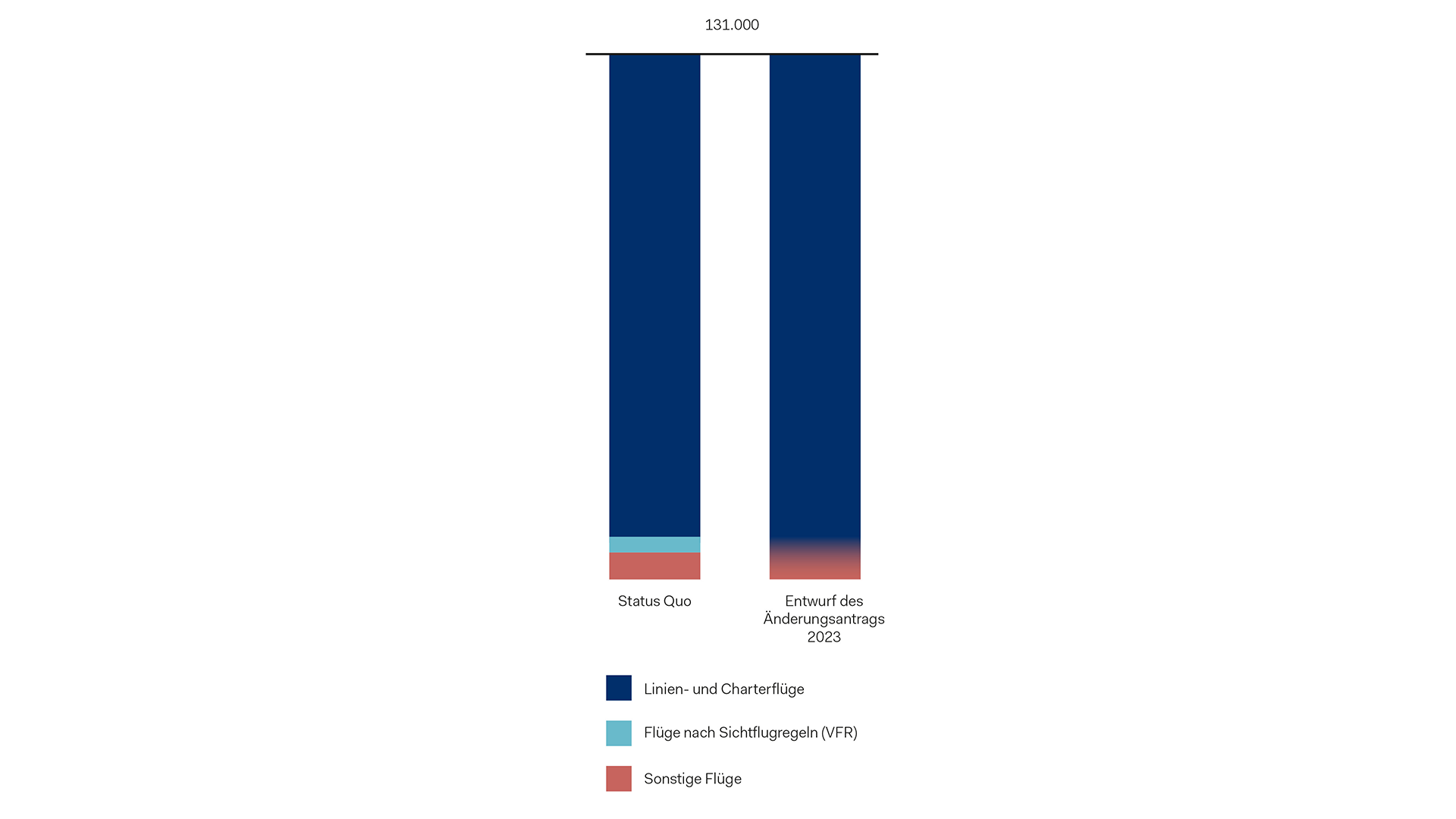
Unlike before, the new concept allows the limit below the capacity cap to be allocated more flexibly according to actual demand. In future, up to 128,000 flight movements will be available for scheduled and charter traffic and at least 3,000 other flight movements. The number of flight movements that may be coordinated during the two-runway hours throughout the day is to be increased from 47 per hour to 60. The airport is therefore not applying for any additional takeoffs and landings beyond the valid capacity cap. Instead, flight operations will gain flexibility so that operational processes can be optimized and disruptions resolved more quickly.
Relief for the neighborhood
The new concept takes the needs of local residents into account more than before. More flexible use of the runways opens up new opportunities to improve punctuality and thus also counteract delayed night flights. The current fee schedule at Düsseldorf Airport also provides airlines with significant financial incentives for punctual landings and the use of modern, low-emission aircraft.
Proven limits remain in place
The reliable capacity limit remains in place, and the night flight rules are still strictly enforced. No scheduled or charter flights may be planned between 11 p.m. and 6 a.m.; between 10 p.m. and 11 p.m., only 33 landings per day are permitted. Takeoffs are not allowed. Exceptions apply exclusively to medical emergencies, meteorological emergencies, or small aircraft. This makes Düsseldorf one of the commercial airports with the strictest night flight rules in Europe. The Angerland comparison remains valid. All aspects covered therein, such as the subordination of the north runway, remain unchanged.
Tolerance for home base airlines
Home base carriers remain flexible. Delayed aircraft have a one-hour tolerance in the morning and evening to return to their home airport in Düsseldorf. This keeps the location attractive for them.
Transparent for everyone
Airport operations remain transparent: what happens at the airport continues to be publicly visible in real time. The TraVis software displays precise information on all departing and arriving aircraft.
The capacity cap remains in place – 131,000 flight movements in the six busiest months